Thursday, November 13, 2014
Replication NFS
Multiple location support in the automounter implements a simple network load-balancing scheme for replicated filesystems. At first glance, this seems to be a bit of overkill; after all, you don't need or want replication for read-write filesystems. However, serving large, read-only filesystems such as the manpages may add to an NFS server's request load. Having multiple servers share this load improves performance by reducing the total load placed on the most heavily used servers. Ideally, you want clients that are "close" to each server to mount its filesystems, reducing the amount of traffic that must go through bridges or routers.
For example, if you have four NFS servers that each export the manpages, the best client mounting scheme is probably not to have one-quarter of the clients mount/usr/man from each server. Instead, clients should mount the manpages from the server that is closest to them. Replicated filesystems are included in automounter maps simply by listing all possible servers in the map:
/usr/man -ro wahoo:/usr/man mahimahi:/usr/man \ thud:/usr/man onaga:/usr/man
The backslash at the end of the first line continues this indirect map entry onto the next line. If more than one server:directory pair is listed in an automounter map, the automounter pings all servers by sending a request to the null procedure of all NFS servers. From the set that responds, the automounter picks one that is "closest" by comparing the address of the servers with that of the clients. Ties are broken by using the server that responded to the ping first. The selected server is used by the automounter to serve the mount point.

Friday, October 24, 2014
Postfix SPAM BUG
Postfix Bug
Sometimes you think that 2+3 =5 and 3+2 you will get also 5. But on point of view of programmer, you will get differents answers.
One of my servers was under attack, i realize because i have a lot of traffic. I got some calls, the system is broken, slow.....
I got into the server and nothing wrong. But the calls were up. The second time, when i was in the server, i find something wrong. What i see, a new user lol.... i mean, the email xyz@mydomain.com was sending a bulk emails to comcast.
The xyz@mydomian.com doesn't exist, but postfix dont realize about it. if you are using sender controller over postfix, you have to know this bug.
My old main.cf was
smtpd_recipient_restrictions =
permit_mynetworks,
permit_sasl_authenticated,
reject_sender_login_mismatch,
reject_unauth_destination,
reject_unlisted_recipient,
reject_invalid_hostname,
reject_unauth_pipelining,
reject_invalid_hostname,
reject_unknown_recipient_domain,
reject_unauth_pipelining,
reject_unknown_sender_domain,
reject_non_fqdn_recipient,
reject_non_fqdn_sender,
I spend all day and i see that it was a bug, very simple to fix only change the lines. Now only pepelupe can send email by pepelupe@mydomian( no more xyz@mydomain)
smtpd_recipient_restrictions =
permit_mynetworks,
reject_sender_login_mismatch,
permit_sasl_authenticated,
reject_unauth_destination,
reject_unlisted_recipient,
reject_invalid_hostname,
reject_unauth_pipelining,
reject_invalid_hostname,
reject_unknown_recipient_domain,
reject_unauth_pipelining,
reject_unknown_sender_domain,
reject_non_fqdn_recipient,
reject_non_fqdn_sender,
i hope that no one have to waste time with it.
Sometimes you think that 2+3 =5 and 3+2 you will get also 5. But on point of view of programmer, you will get differents answers.
One of my servers was under attack, i realize because i have a lot of traffic. I got some calls, the system is broken, slow.....
I got into the server and nothing wrong. But the calls were up. The second time, when i was in the server, i find something wrong. What i see, a new user lol.... i mean, the email xyz@mydomain.com was sending a bulk emails to comcast.
The xyz@mydomian.com doesn't exist, but postfix dont realize about it. if you are using sender controller over postfix, you have to know this bug.
My old main.cf was
smtpd_recipient_restrictions =
permit_mynetworks,
permit_sasl_authenticated,
reject_sender_login_mismatch,
reject_unauth_destination,
reject_unlisted_recipient,
reject_invalid_hostname,
reject_unauth_pipelining,
reject_invalid_hostname,
reject_unknown_recipient_domain,
reject_unauth_pipelining,
reject_unknown_sender_domain,
reject_non_fqdn_recipient,
reject_non_fqdn_sender,
I spend all day and i see that it was a bug, very simple to fix only change the lines. Now only pepelupe can send email by pepelupe@mydomian( no more xyz@mydomain)
smtpd_recipient_restrictions =
permit_mynetworks,
reject_sender_login_mismatch,
permit_sasl_authenticated,
reject_unauth_destination,
reject_unlisted_recipient,
reject_invalid_hostname,
reject_unauth_pipelining,
reject_invalid_hostname,
reject_unknown_recipient_domain,
reject_unauth_pipelining,
reject_unknown_sender_domain,
reject_non_fqdn_recipient,
reject_non_fqdn_sender,
i hope that no one have to waste time with it.
Tuesday, October 21, 2014
Lets talk about Interprocess Communication
An Overview of RMI Applications
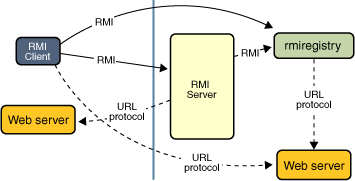
RMI applications often comprise two separate programs, a server and a client. A typical server program creates some remote objects, makes references to these objects accessible, and waits for clients to invoke methods on these objects. A typical client program obtains a remote reference to one or more remote objects on a server and then invokes methods on them. RMI provides the mechanism by which the server and the client communicate and pass information back and forth. Such an application is sometimes referred to as a distributed object application.
Distributed object applications need to do the following:
- Locate remote objects. Applications can use various mechanisms to obtain references to remote objects. For example, an application can register its remote objects with RMI's simple naming facility, the RMI registry. Alternatively, an application can pass and return remote object references as part of other remote invocations.
- Communicate with remote objects. Details of communication between remote objects are handled by RMI. To the programmer, remote communication looks similar to regular Java method invocations.
- Load class definitions for objects that are passed around. Because RMI enables objects to be passed back and forth, it provides mechanisms for loading an object's class definitions as well as for transmitting an object's data.
Wednesday, October 15, 2014
Broadcast on RPC
According to Peters broadcasting is the audio or video distribution to a dispersed client via any electronic mass communications medium, it usually use spectrum (radio waves), in a "one to many" model.[1]
Tuesday, October 14, 2014
What is RPC
Remote Procedure Call:
As you has seen before The sockets are very useful, but one of the most common problems is transformations data on the network. This transformation data will be use as the representation used by the application and its called as "Presentation Formatting" (Morgan Kaufman,2007).

As you has seen before The sockets are very useful, but one of the most common problems is transformations data on the network. This transformation data will be use as the representation used by the application and its called as "Presentation Formatting" (Morgan Kaufman,2007).
Thursday, October 2, 2014
Lazaro get up and walk
Today , i was talk' with one of my students . He asked to me "how to run a linux over pentium II".
I realized that its a very old device. And the new linux only work for P IV up to.
Then i find the link that could be good to work about it.
https://help.ubuntu.com/community/LubuntuLinks#Section_B:_Lubuntu_101
i hope that it could be good for us.
I realized that its a very old device. And the new linux only work for P IV up to.
Then i find the link that could be good to work about it.
https://help.ubuntu.com/community/LubuntuLinks#Section_B:_Lubuntu_101
i hope that it could be good for us.
Wednesday, October 1, 2014
Subscribe to:
Posts (Atom)